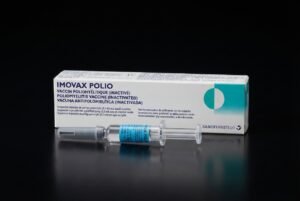
Protects against:
- Poliomyelitis (polio), caused by poliovirus types 1, 2, and 3 — a disease that can cause permanent paralysis and death
Who should get it:
- All infants and children as part of the routine childhood immunization schedule
- Adults known or suspected to be unvaccinated or incompletely vaccinated against polio
- Adults at increased risk of exposure — healthcare workers handling specimens that might contain poliovirus, laboratory workers, and travelers to countries where polio risk is elevated
- Especially important for people from or traveling to regions using oral polio vaccine (OPV) or with recent circulating poliovirus, since OPV-only vaccination may leave gaps against certain poliovirus types
Schedule:
Children (routine 4-dose series):
- Dose 1: 2 months
- Dose 2: 4 months
- Dose 3: 6 through 18 months
- Dose 4: 4 through 6 years
- Minimum age for the first dose is 6 weeks; doses must be given at least 4 weeks apart
- Some combination vaccines (e.g., Pentacel, Pediarix, Vaxelis) may result in a 5th dose being given — this is safe
Unvaccinated/incompletely vaccinated older children and adults (catch-up):
- 2 doses of IPV separated by 4–8 weeks, then a third dose 6–12 months after the second
- If an accelerated schedule is needed: first two doses at least 4 weeks apart, third dose at least 6 months after the second
- The final dose must be given after the 4th birthday
Accelerated schedule for travel (children):
- Dose 1 at 6 weeks or older, Dose 2 ≥4 weeks later, Dose 3 ≥4 weeks after that, Dose 4 ≥6 months after Dose 3
Duration of protection:
- IPV protects 99–100% of people who complete all recommended doses, with long-lasting immunity
- Adults with completed vaccination but increased ongoing exposure risk may receive one lifetime IPV booster — not a routine booster for the general public
Why vaccinate:
- Polio can cause irreversible paralysis, and in severe cases, death from respiratory muscle paralysis
- IPV does not contain any live virus and cannot cause polio — unlike oral polio vaccine (OPV), which is not used in this injectable form
- Global polio eradication efforts depend on maintaining high vaccination coverage, since the virus can still circulate in under-vaccinated populations
Important note:
- Children or adults who only received bivalent OPV (used since April 2016) are not protected against poliovirus type 2 and need to complete an IPV 3- or 4-dose series depending on age
- A child’s record from a country using OPV may show more doses than the U.S. schedule requires — some of those doses may not count as valid under U.S. criteria
- There are no known risks to giving IPV at the same time as other vaccines
- Since Pakistan remains one of the last polio-endemic countries and still uses OPV in campaigns alongside IPV in routine EPI, your HMIS should track both dose type (OPV vs IPV) and count separately per child — mixed-series patients are common in your patient population, and catch-up logic needs to account for that history rather than assuming a clean IPV-only record.